my email address: yvonnelau78@gmail.com

Sunday, August 8, 2010

ART ON COLOURS OF OUR WORLD

The above art was done by my eldest son when he was 12. I've asked him to help me come up with a banner for the school, and this is what he has done. It was done in acrylic, and was not easy as the paint dries very fast. Although it was meant to be for our theme on occupation, it is also apt for Colours of the World, as our world consists of many diverse cultures and races, and we should love and respect each other. Only then will we achieve harmony and greater beauty for all.

Art has always been an integral part of our curriculum. That is why we have two experts in this field to teach, guide and lead our children. Creative arts such as music and movement, story-telling and drawing/painting/craft are all ways of self-expression, instilling discipline as well as encouraging the children to see out of the box (cliche though it may sound!) so that they do not excel only academically.

The following are some of the work that we have done in relation to Colours of the World.


LOLLIPOPS - the whirls of the lollipop depicts the world in motion. The lollipop carries the message of my world as a sweet, colourful and beautiful one. Children love the colours and the candy-sweetness of lollipops. (Fortunately, they know that too much lolli is no good for teeth!)
This 3D craft gives the children opportunity to scrunch the cellophane paper and glue them onto the art block. Great for fine motor skill, hand-eye coordination and developing patience and concentration.


Printing using okra or ladies fingers. Somehow the children have the patience to meticulously print each okra beautifully onto the art block.


Non-objective art - arts that is not representational. It eliminates the idea of depth and instead focus on composing a harmonious arrangement of grids, shapes and colours. Beautiful creation from the children. Most use their intuition to come up with the masterpieces as they were all given a free hand to compose their own piece.


The Big Orange Splot by Daniel Manus Pinkwater is a marvellous book about not conforming to standard norms and living up to our individuality. It tells the story of Mr Plumbean who dared to change his house according to his personality, despite objections from his neighbours. "My house is me and I am it. My house is where I like to be and it looks like all my dreams."

After telling them the story, I encouraged the Navy Beans to draw me their dream house. This is what they have!

Everyone's is different, although there were many castles from the girls. All wanted a lovely house, filled with warmth and love.

Rachel's house is a colourful, checked house.


Gavin's is a submarine!


Shannon's is a candy-sweet and every thing nice! Notice the little girl at the bottom right.

Another book that we discussed was Color Dance by Ann Jonas. This is a very good book that introduces colour-mixing as well as names of different shades of green, purple and orange. I want the children to learn names of colours beyond the common ones such as vermilion, chartreuse and magenta.


My next project is to let the children mix their own colours to form the above palette of blue, aquamarine, green, chartreuse, yellow, marigold, orange, vermilion, red, magenta, purple and violet.

COLOURS OF OUR WORLD

COLOURS OF OUR WORLD - that's our theme for the last two weeks of July. There are so many interesting activities that we can do with regard to this theme. Incidentally, this is also the theme for our concert this year.

We wanted to highlight that our world is made up of a myriad of colours. These colours are often taken for granted, unless we take the time to sit down and ponder on their beauty. Children are more receptive and observant to the changes of colours around them. Unfortunately, as we grow older and busier, we forgot to admire the beauty of nature. Remember the time you are driving in the car, or outside in the porch. Who will be the first to notice a rainbow in the sky? Usually, it's a child .... We are always in a hurry, and in the process hurry our children along. I know I am guilty of this!

Colours create different emotions. Let us be aware of this, and let us use colours to depict our emotion positively. Take for example, red. Red can be a colour of courage and love, at the same time, it can be a colour of anger and danger. Green represents life, a new beginning but it is also a colour of jealousy. Blue is full of optimism, hope but on the negative side, it can be a sad, sad colour. What did we choose to do? How do we want to represent these colours to the children? Positively, of course. We want them to see the world as a colourful, beautiful place to live in and cherish, but I think we should also be responsible to nurture and guide them on the possible dangers - take care of our planet and keep it clean and safe for future generations. Also, red as a danger sign is important for safety reasons- the red at traffic lights means STOP.

There are endless activities that we can do and we will continue to do so through the years. However, below are some of them. Not all are shown, though!


We started by getting the children involved in created the Tree - important for sustaining our planet with fresh air. The leaves are green, depicting life and growth.


The final theme board - many leaves, flowers, butterflies and insects.


The children and teachers also created many items, representing the objects around us.


We have created a 'rainbow' inside the school. Children have a visual impression of the colours of the rainbow and know the sequence of the colours very well.
The wall on the left depicts Colours Of Little Beans - all our children are there!


We did colour-mixing (2 primary to create a secondary colour) with food coloring in water, in milk (beautiful swirling effect) as well as
cellophane papers as shown above and below.


We played colour games on colourful mat, tossing bean bags, colourful dice, jumping or walking on the different colours, etc.


We looked and studied different colourful objects, some real and some made, such as the rubber fruits and utensils above.


We made our own rainbow and dance with them!

We even caught a rainbow using a basin of water and mirror!
We've done so many activities that are not listed here as well such as blowing bubbles, singing songs, reading children's classics such as Green Eggs and Ham by Dr Seuss, Colour Dance, Freight Train and a amazing book titled The Big Orange Splot!

Last, but not least, the teachers also showed the children different colours of salt and sugar. Have you ever noticed the different shades of brown and white sugar or the actual colour of different salt?

FRUITS GALORE


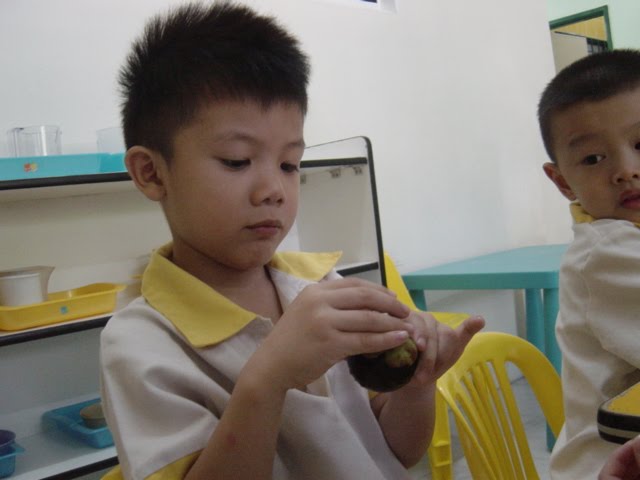
How to I open this mangosteen???

The MPs and VIPs have been having many fruit parties and feasts recently. So, I think, why not us??? It'll be a great opportunity to introduce them the the variety of fruits from Malaysia. All the children had the chance to sample various fruits (besides apples and oranges), unfortunately, I was not around all the time to capture these with my camera. These are just snippets of what happened during the various fruit parties... which we had at different days of the week.


We introduced mangosteen, rambutans, water apples as well as longan, guavas, kiwi and papayas and bananas to the children. Some have not eaten rambutan or mangosteen before and were hesitant to try. Some, of course, wanted more!
My six-year olds were amused when I played the guessing game with them involving the mangosteen. How many pulps of flesh can you guess without opening up the mangosteen?
Wild guesses from 6 to 20 came from the children. I showed them the 'petals' at the bottom of the mangosteen and explained that whatever the number of petals is shown is equivalent to the number of pulps inside. And, a mangosteen usually have 4 to 5 pulps only!


A fruit picnic... and a great tasting begins. Too bad, the King of Fruit is not around.
Any sponsors?


Teacher Yvonne, can we have some more, please?


What is that funny-looking fruit? Does not look like a queen at all!


Looking and comparing the different seeds of the fruits

How long more do we have to wait???

SHADOW PLAY

We did a unit on shadow and reflection as part of our Junior Scientist programme. This is what the children and I discovered:

Shadows are created when light passed through an opaque object. Shadow is darker when the object is more opaque and is lighter when the object is translucent. It is hardly visible when the light passed through a transparent object.


The shadow becomes bigger and blur it it is far from the light source but becomes smaller and more distinct when it is nearer to the light.


We had a great time discovering all these through our shadow play and even created a storyline
to go along with our props.


Wise old owl, wise old owl,
In the tree, in the tree
Whoooooo are you thinking of?
Whooooooo are you thinking of?
Is it me? Is it me?


We also talked about reflections from mirror, a basin of water, pot lids, etc. I explained that we can see what is not visible directly to our eyes through mirrors, such as those used in a submarine. One such equipment is the periscope.

We went outside and looked (spied) the happenings in the dining room through our hand-made periscope. Amazing discovering for the children as well as myself!


Sunday, August 1, 2010

stART


I'm very proud of Javen. First, he performed in front of a big crowd in UCSI and without any jitters. Secondly, he performed together with a group of under-privileged children, to raise funds for the StART Society.


How did this come about? Well, his guitar teacher invited him to join some of his students to perform in a charity concert. He thought that it will be a great exposure for him to perform in front of a crowd. I agree, but I think that this is a great opportunity for him to get to know some other children who are not as lucky as him.


Javen and his brothers are so lucky; they have everything that they need - family, home, food and material things. Other children are not so lucky and some may even have to worry about their very next meal, while some have lost their parents or not even know who their parents are. This group of children who were performing with him are orphans, and I wanted Javen to get to know them. As a friend mentioned, that night Javen was a little boy with a big heart. Honestly, Javen went there to have fun, get to know some new friends as well as to get on stage and play his guitar. He may not fully understand the significance of his action but in many years to come, I'm sure he will understand better.


Here, let me explain that nights' event. It was a charity concert "Music Brings Us Together" organised by UCSI's School of Music first year students as part of their final semester coursework. They collaborated with StART Society to present the concert. Donation was collected and all proceeds from this concert was donated to StART.


Let me explain StART by lifting out the words from their leaflet.


The StART Society

The first of its kind, StART Society is an academy dedicated to serve underprivileged children. In essence, we use the arts (music, drama, speech, writing, design, etc) for the betterment of these children.


Our role is to help them find their natural talent; allow the various art forms to bring healing; encourage and nurture these talents; allow their newly acquired talent to rebuild their self-esteem and confidence; and possibly help them carve out something that will give them a brighter future.


Our mission

Through the healing and liberating power of the arts, StART provides underprivileged and at0risk children a safe format to express and articulate emotions, and for them to learn and grow into confident, responsible Malaysians. StART gives happy endings to all.


Our vision

To provide a fun, healthy, safe and educational experience on a weekly basis for these children. To build long term mentor-mentee relationship and trust. To impart and nurture skills in music, art, drama and dance. To see emotional and mental wholeness. To elevate self-confidence and a healthy self-image. To see these children thrive in the arts. To see them use arts as their career or provide a side income (art directors, singers, writers, etc). To see them come back to the centre to inspire the next generation of underprivileged kids.


I salute the volunteers for their commitment and dedication towards this course. For more information, you can read about them from a link in my facebook.